Orcs are a race of strong and resilient humanoids, characterized by the tusks of their lower jaws.
Appearance
Exandrian orcs can reach a height of eight feet and are muscular, weighing up to 280 pounds.[6] They are known for the prominent tusks of their lower jaws, with some orcs having impressive teeth, big enough to be adorned with rings,[7] while others' are smaller, and more similar to those of half-orcs.[8]
History
When the Shapers came to Aramán and the people of Kahad became their followers, Azgra the Conqueror, the Shaper of War, turned his portion into the orcs.[9] He shaped the orcs to be fearless and resourceful. He was also the only one of the Shapers to offer his creations no salve for the afterlife, but only the promise of more pain.[10] As a result of this, the orcs frequently rebelled against Azgra.[11]
The last of their rebellions was the Shapers War, which spread to involve all the Shapers and their peoples, and eventually resulted in the death of the Shapers.[12][13]
At least a portion of the orcs are known as the Rungjani,[14] which is also the name of their language.[15]
Early history and supposed creation in Exandria
Orcs' origins on Exandria are shrouded in legend, and some of their creation myths are known to be false.
Orcs had existed for a long time as the Age of Arcanum drew to a close, and by then half-orcs were already a race by themselves, as the product of the interaction between the orcs and other humanoids.[16][17]
During the first century of the Calamity,[18] when Corellon pierced the eye of Gruumsh, his blood seared elves in the field, who became vengeful and orc-like. According to legend believed in the Post-Divergence era, that was the point when the race as a whole was created,[5] although others contend that the Ruiner created the race by himself;[19] both of these versions are untrue, and are spread by Gruumsh and his followers because he wishes to take credit for their creation.[20] Those new orcs lost their initial instinctive bellicosity when that battle ended,[21] and despite their transformation, some of them sought out their elvish kin: in Marquet they joined in a utopian city that would later be known as Cael Morrow, the "Drowned City", when the Ruiner, in his anger, shunted it deep into the earth.[22]
Due to this supposed general connection with Gruumsh, many believe that all orcs and half-orcs have the blood of Gruumsh, driving them to a violence and anger orcs call hgar'Gruum, the curse of ruin. Despite widespread belief in this among the orcish and among others, the curse of ruin does not exist, and orcs are only drawn to violence and anger for the same natural reasons as other mortal creatures.[5]
Era of Reclamation
After Gruumsh was defeated and banished, many of his orcish war clans splintered and went into hiding. Included among these were the Odakar orcs who held the Ashkeeper Peaks. Splitting from this group were some leaderless droves who migrated north into the Rime Plains, and these orcs suffered a schism between those who succumbed to Gruumsh's influence (the Jez-Araz marauders) and those who found inspiration in Kord, the Stormlord (the Boroftkrah clan). The latter went on the create the eponymous settlement of Boroftkrah.[19]
Some orcs settled around the site of one of the bloodiest battles of the Calamity, which had plenty of weapons to salvage; this settlement was called Bladegarden, and for a time it was a part of the Julous Dominion. After the Julous Dominion fell to the Dwendalian Empire, the empire reached out to some of the more approachable members of the settlement, offering wages and access to goods and services. Many accepted, and Bladegarden was incorporated into the empire; other orcish clans who disagreed with this accord were driven east towards the Brokenveil Marsh.[23][24]
Campaign One: Vox Machina
"Trial of the Take: Part 1" (1x18)
Near the Glasswalk Road in Othanzia, a raiding party of orcs, accompanied by an orc-ogre hybrid (called an ogrillon[25]) and a dire wolf, attacked the camp of Grog, Lyra, Percy, Scanlan, Vex'ahlia, and Zahra Hydris as the adventurers trekked north to hunt a white dragon. The last surviving orc gave them limited information before Grog executed him.[26]
Campaign Two: The Mighty Nein
"The Gentleman's Path" (2x19)
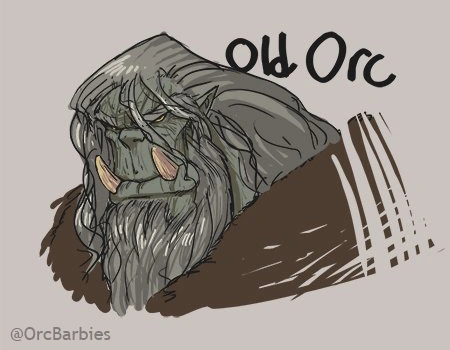

Fan art of the unnamed orc on the Bromkiln Byway, by OrcBarbies.[art 2]
"Beneath Bazzoxan" (2x66)
On their way to Bazzoxan, the Mighty Nein raced on moorbounders past a small settlement of orc marauders in the Barbed Fields. They deployed a fireball and an insect plague to discourage the warg-mounted orcs from following.[28]Society
Marquet
To the south of the Rumedam Desert and Panagrip Sands are the Gloomed Jungles of Aeshanadoor, home to an erudite orcish society called the Court of the Lambent Path in the city of Yios.[29]
Tal'Dorei
Unlike certain races of the continent, clans of Gwessar orcs didn't hide from The Calamity but fought in god-scale, gory battles set on the Dividing Plains, surviving through their sheer endurance, aspiration, and perhaps in part because of the divine power behind their creation. When the war was over, their fury faded out.
In the early days of Gwessar, orc clans were belligerent to anyone who invaded their territory, especially the goliaths who left their mountain shelters where they waited out the Calamity and descended to the plains, and who possess incredible strength and physique to rival orcs'. But common sense prevailed even among the most passionate warmongers and the conflict subsided over time.[21]
In 836 PD, orcs and their descendants live all across Tal'Dorei, many of them in specific trades intertwined with their physique, but they work in other professions as well. Though orcs and humans have a long rooted legacy of conflict with prejudice as the cause, the realm is filled with people who denounce and ostracize individuals who discriminate against their orc neighbors.[30]
Dwendalian Empire
Bladegarden is both a military training complex and the core of orcish society within the Empire; it secures the empire's eastern border.[31] Following the incorporation of Bladegarden into the Empire, orcs are among the most celebrated imperial soldiers, but many folk still fear the Curse of ruin.[1]
Menagerie Coast
Orcs and half-orcs alike, believing that the curse of ruin caused them to lash out at loved ones, seek respite in the city of Othe via spiritual peace and belonging.[1]
Greying Wildlands
The orcs of Boroftkrah have a strong community that communes with Kord (particularly during thunderstorms) through contests of tracking and hunting, and makes offerings of strong prey. The settlement welcomes outsiders who are strong in the eyes of Kord, but it clashes frequently with the Jez-Araz and sometimes with hunting parties from Uthodurn. The community includes some orogs,[32] a type of orc set apart from the rest of their kind by their strength and amazing cunning and intellect.[33]
Xhorhas
Xhorhasian orcs primarily live in nomadic, mixed bands with humans and bugbears, taming the beasts of the wastes and mostly trading peacefully with the Kryn Dynasty. Though nomadic orcs welcome the city-folk of the Dynasty to join their clans, they become angered when Kryn souls are reborn in orc bodies.[1]
Due to the superstition about the curse of ruin, it is strictly taboo for orcs and goblinkin to have children, as the latter are known to carry the all-too-real Curse of Strife and the nomadic elders fear the madness that would come from a soul afflicted with both curses. So despite living in bands with bugbears, most half-orcs in Xhorhas have human or drow blood.[1]Connection with divinity
The Shapers
The Shapers were the seven gods of creation worshiped in the world of Aramán. They received that name because, after they first manifested in this world, they took the humanoid people they found on the continent of Pasitar and changed them into new species; for two examples, one of these Shapers was responsible for the creation of orcs, while another, Sylandri, created the elves.
When the orcs realized that their situation under their particular Shaper was more harmful than beneficial, they started creating weapons to attack that deity. In response, the other six members of the pantheon organized to help their divine peer, which caused some of their own followers to realize the gods they were worshiping cared more about the worst of their own than about their creations. This led to the Shapers' War, during which, one by one, the gods of Aramán were defeated and destroyed.[34]
Exandrian deities
Like other mortal races, orcs have the free will to choose what deities they worship, or if they worship anything at all. Whenever they face religion, members of this race often take into account aspects such as the nature of the deity in question or their own history. This is reflected in the worship of Kord, a god who appreciates fierce nature and physical prowess;[32] Corellon, the elven deity worshipped by the ancestors of some of the orcs;[35] or Gruumsh, who tries to influence this race and claim it as his creation.[20]
However, sometimes certain orcs' devotion and/or innate connection to divinity grants them unusual abilities that set them apart from their peers.
Orc Eye of Gruumsh
One adventure hook set in Boroftkrah involves an orc eye of Gruumsh leading orcs and orogs.[36] In the Monster Manual, which includes lore that is not Exandria canon, "eye of Gruumsh" refers to an orc particularly devoted to the Ruiner. After a bloody slaughter against their god's enemies, the orc in question sacrifices one of their eyes in honor of the loss of Gruumsh's eye. If he is pleased, he rewards the new Eye of Gruumsh with increased strength and physical resistance, as well as the ability to channel his power to cast spells. In places where there is a cult of the Ruiner, the Eyes of Gruumsh are usually the ones who lead them.[33]Notable orcs
Campaign 2: The Mighty Nein
NPCs
- Lukash: in charge of construction and organization of the Vo village on Rumblecusp
Critical Role: Call of the Netherdeep
Tal'Dorei Campaign Setting Reborn
- Tevrosk, Whose Axe Was Wreathed in Flowers: a lesser idol and a secluded champion in Tal'Dorei.[37]
- Cressida Holt: an expositor of the Cobalt Reserve in Tal'Dorei.[38]
Campaign Three
NPCs
- Lord Ariks Eshteross: Deceased mercenary and bodyguard who became a reclusive figure of note in Jrusar who hired the Bells Hells and was their first powerful ally
- Manad: Werepanther and member of the Gorgynei
- Mythtaker Qi Mandozi: Spellcaster from Aeshanadoor
Campaign Four
PCs
- Halandil Fang: Bard connected to Dol-Makyar (see below)[39]
- Thaisha Lloy: Druid connected to Dol-Makyar[39]
NPCs
- Loza Blade: Mercenary warrior who fought for the Torn Banner during the Falconer's Rebellion alongside Thjazi Fang and others PCs
- Thjazi Fang: Revolutionary adventurer whose execution is the inciting incident of Campaign Four; half-brother of Halandil Fang
Behind the scenes
The orc racial traits published in Explorer's Guide to Wildemount were first published in Eberron: Rising from the Last War,[40] differing greatly from the orc racial traits published in the Volo's Guide to Monsters. The Explorer's Guide to Wildemount version also differs from the Eberron version in that it increases the lifespan and maturity rate of orcs.
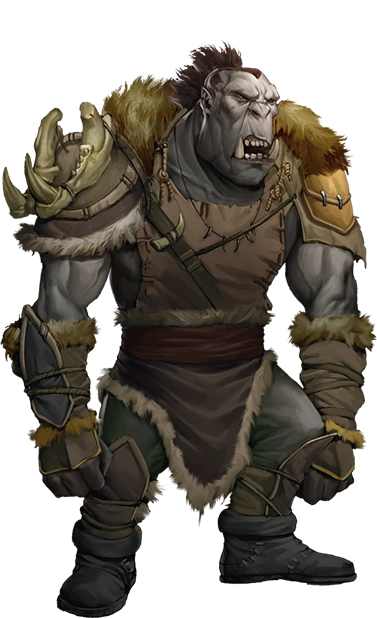

Depiction of an orc, by Conceptopolis from D&D Monster Manual, 5th ed., p. 246.[art 3]
In the Tal'Dorei Campaign Setting, in Tal'Dorei as of 812 PD, nearly every living orc was a ruthless killer, the word "orc" is associated with slaughter, and the exceptions were uncommon enough that people didn't believe stories about tender or merciful orcs.[41] Most orcs lived in wandering bands between the Stormcrest Mountains and Cliffkeep Mountains,[41] and nearly every orc in the Dividing Plains is part of the Ravagers, most willingly.[42] Ruthless and violent, the Ravagers worship Gruumsh and follow his commands to conquer and destroy and to feel nothing but fury or joy; they are sometimes hypnotized by their god's gaze from beyond the Divine Gate and fall into a strange bloodlust.[43] Orcs are described as being driven to chaos and destruction either through resentment created by the prejudice of other races or through "the corruption of the Ruiner's blood" driving them to all-consuming fury. However, some orcs are pushed to acts of compassion and tenderness by "what remains of their human and elven ancestry" despite the influence of Gruumsh's blood, which goes unnoticed by the rest of Tal'Dorei as no one has studied the orcish peoples.[42] Humans hold little remorse for orcs and view them as savage, bloodthirsty, and bestial.[41] Orcs are considered "a threat to civilization", albeit a mindless and uncoordinated one;[41] they are characterized as generally struggling to structure and lead their bands, though "with each generation, some orcs grow smarter" and more organized.[42]
Aspects of this lore, specifically in the existence of a corruption from Gruumsh's blood driving orcs to fury and in that displays of orcish compassion come from human and elven ancestry, were superseded by the Explorer's Guide to Wildemount, which refuted the existence of a blood-borne curse from Gruumsh and asserted orcs are not inherently driven to violence more than any other mortal.[1] In other places, Explorer's Guide to Wildemount reiterates lore in the Tal'Dorei Campaign Setting, such as Gruumsh's ability to hypnotize those who already serve him (though it also expanded worship of Gruumsh beyond orcs).[44] In "Explorer's Guide to Wildemount Q&A and Fireside Chat with Matthew Mercer" (Sx53), Matthew Mercer said, in discussing the narrative treatment of orcs in the Exandria and in Explorer's Guide to Wildemount:
- "I've been in a discussion for a while amongst a lot of creators in this space that orcs always got the shaft, even though where they were born from, and really came to prominence in the Lord of the Rings as this kind of— this idea of industrialization and the evil of, in many ways, of an exploitative capitalist society. A lot of that also lent to orcs being an unnecessarily lambasted and evil-touted entity in a lot of media. I fell into that as well. [...] With Wildemount, I wanted to explore the aspect of evil as— morality is relative, but evil is born from experience and intent, not from bloodline. Not from lineage. So when we came around to making this book, it was very important that we've managed to steer away from that classic idea of the orcs. Even the marauders that we had situated in Tal'Dorei's campaign guide, which was meant to be just one facet, but even then, there were facets of that book that were lazy, looking back on it. I'm not necessarily very proud of that."
- —"Explorer's Guide to Wildemount Q&A and Fireside Chat with Matthew Mercer" (Sx53) from 0:48:47 through 0:50:54
In July 2021, the Tal'Dorei Campaign Setting Reborn was announced to update lore presented in the Tal'Dorei Campaign Setting, including a "serious overhaul" to the races section according to writer James Haeck.[45] In the new campaign guide, orcs' minds did burn with blood thirst immediately after their creation in the Calamity, but it burned away after that battle between Gruumsh and Corellon. They warred with anyone who invaded their territory, especially the goliaths and for a long time humans, but eventually those conflicts cooled and there has even been love stories coming out of the interactions between these folks.[30]
Starting with Mordenkainen Presents: Monsters of the Multiverse in 2022, and continuing with the updated rules in 2024, 5th Edition has created a variation of the classical orc with racial traits less based on their "natural" tendency to fight (with Aggressive being reworked as "Adrenaline Rush" and having limited uses between rests, although gaining temporary hit points with each use), and having the half-orc's iconic Relentless Endurance instead of Primal Intuition.[2][46]
In materials released on Critical Role channels on August 21, 2025, Brennan Lee Mulligan said that his ideas of Aramán were formed "in conversation with Exandria", where the Calamity helped explain much about how that world came to be what it was; in Aramán, a different choice was made regarding divinity. Thinking a lot about J.R.R. Tolkien's Middle-earth, where Brennan saw orcs as Sauron's greatest victims, and asking himself what would happen if the orcs, noticing the damage Sauron was doing, figured out a way to throw off their Sauron figure, he had a vision of a proud, heroic orcish revolution.[47]
Trivia
- In the lore of the Monster Manual, orogs' physical and intellectual abilities are said to be granted by Luthic, a minor cave goddess connected to Gruumsh (often seen as his wife), and orogs are respected in the cult of the Ruiner as worthy warriors;[33] Luthic and her potential connection to orogs have not been mentioned in Exandrian canon.
- In the world of Aramán, most of the known orcish family names, such as Blade, Claw, Fang, and Howl, are short, guttural, and warlike due to the violent culture imposed by Azgra until they defeated him.[48]
References
- ↑ 1.00 1.01 1.02 1.03 1.04 1.05 1.06 1.07 1.08 1.09 1.10 See Explorer's Guide to Wildemount, p. 178.
- ↑ 2.0 2.1 See D&D: Mordenkainen Presents: Monsters of the Multiverse, 5th ed., p. 28.
- ↑ See "The Gentleman's Path" (2x19) at 1:42:21.
- ↑ See D&D: Monster Manual (2014), 5th ed., p. 246.
- ↑ 5.0 5.1 5.2 See Explorer's Guide to Wildemount, pp. 177–178.
- ↑ Note that the description of orcs and the random height calculation do not match up. See Explorer's Guide to Wildemount, p. 178.
- ↑ See "The Eve of the Red Moon" (3x81) at 2:28:48. Qi Mandozi is an example of an orc adorning his tusks with jewelry.
- ↑ See Tal'Dorei Campaign Setting Reborn, p. 173. Both Cressida Holt and the orcish shepherd of page 162 are examples of full-blooded orcs with very small tusks.
- ↑ See "Seeking Sanctuary" (4x13) at 1:08:53.
- ↑ See "King of Cards" (4x21) at 0:22:03.
- ↑ See "To the Hounds!" (4x09) at 0:04:48.
- ↑
 CR Cooldown C4 E001 at 16:55 (subscription required) (Transcript).
- ↑ See "Fireside Chat LIVE With Matthew Mercer & Brennan Lee Mulligan" (August 21, 2025) at 34:53.
- ↑ See "The Giant's Belt" (4x12) at 0:12:09.
- ↑ See "Hand & Wheel" (4x19) at 0:38:52.
- ↑ Orwyn was a half-orc living in Avalir on the eve of the Calamity. See "Excelsior" (E3x01) at 1:32:50.
- ↑
 Matthew Mercer (@matthewmercer) on Twitter: "A good eye! “It is said” that was the point of their creation, largely by those without interest in historical interest (the unreliable narrator of history). While that particular event created a number of “vengeful, orc-like beings under the Ruiner”, they indeed predated it." (2022-05-27) — in reply to @DamontEvermore: "So does that mean that isn't true? Or was that an older battle between Grummsh and Corellon that saw the Orcs emerge onto Exandria and I have things twisted up."
- ↑ See "Downfall: Part One" (3x99) at 0:50:02. There is a centaur by then, and the first Exandrian centaurs were created after the Ruiner lost his eye.
- ↑ 19.0 19.1 See Explorer's Guide to Wildemount, p. 112.
- ↑ 20.0 20.1 Matthew Mercer (@matthewmercer) on Twitter: "The Ruiner wishes to take credit for them, and pushed that narrative through his followers. Revisionist history." (2022-05-27).
- ↑ 21.0 21.1 See Tal'Dorei Campaign Setting Reborn, p. 162.
- ↑ See Call of the Netherdeep, p. 7.
- ↑ Grimgolir was absorbed around the same time Bladegarden was incorporated into the Empire. See Explorer's Guide to Wildemount, p. 86. See also p. 16, about King Alfwin Dwendal "establishing the stronghold of Bladegarden and assimilating Grimgolir into the Empire."
- ↑ This is seemingly contradicted by the statement that Bladegarden was incorporated into the empire "after the fall of the Julous Dominion, nearly three hundred years ago." See Explorer's Guide to Wildemount, p. 178. See also p. 81, on which "When the Julous Dominion was defeated" is quickly followed by, "The empire reached out to the more approachable members of the orc settlement of Bladegarden."
- ↑ See D&D: Monster Manual (2014), 5th ed., p. 238.
- ↑ See "Trial of the Take: Part 1" (1x18) from 1:21:33 through 2:16:50.
- ↑ See "Critical Role Campaign 2 Wrap Up" (Sx56) from 3:59:26 through 4:00:53.
- ↑ See "Beneath Bazzoxan" (2x66) at 1:19:03.
- ↑ See "The Draw of Destiny" (3x01) at 13:54.
- ↑ 30.0 30.1 See Tal'Dorei Campaign Setting Reborn, pp. 162–163.
- ↑ See Explorer's Guide to Wildemount, p. 81.
- ↑ 32.0 32.1 See Explorer's Guide to Wildemount, pp. 112–113.
- ↑ 33.0 33.1 33.2 See D&D: Monster Manual (2014), 5th ed., p. 247.
- ↑ CR Cooldown C4 E001 at 16:55 (subscription required).
- ↑ See Tal'Dorei Campaign Setting Reborn, p. 87.
- ↑ See Explorer's Guide to Wildemount, p. 113.
- ↑ See Tal'Dorei Campaign Setting Reborn, p. 40.
- ↑ See Tal'Dorei Campaign Setting Reborn, p. 60.
- ↑ 39.0 39.1 See the whiteboard in the background in "What Is Campaign Four?" at 10:15.
- ↑ See "Explorer's Guide to Wildemount Q&A and Fireside Chat with Matthew Mercer" (Sx53) at 0:48:47.
- ↑ 41.0 41.1 41.2 41.3 See Tal'Dorei Campaign Setting, p. 126.
- ↑ 42.0 42.1 42.2 See Tal'Dorei Campaign Setting, p. 136.
- ↑ See Tal'Dorei Campaign Setting, p. 20.
- ↑ See Explorer's Guide to Wildemount, p. 27.
- ↑ James Haeck (@jamesjhaeck) on Twitter: "I can't say much more yet, but the races section of this book underwent a serious overhaul." (2021-07-22).
- ↑ See D&D: Player's Handbook (2024), 5th ed., p. 195.
- ↑ See "Fireside Chat LIVE With Matthew Mercer & Brennan Lee Mulligan" at 30:22.
- ↑ See "Make Merry" (4x11) at 1:06:20.
Art:
- ↑ Official art of an Exandrian orc shepherd, by Nikki Dawes from Tal'Dorei Campaign Setting Reborn, p. 162. This file is a copyrighted work. Its use in this article is asserted to qualify as fair use of the material under United States copyright law.
- ↑ Fan art of the unnamed orc on the Bromkiln Byway, by OrcBarbies (source). Used with permission.
- ↑ Depiction of an orc, by Conceptopolis from D&D Monster Manual, 5th ed., p. 246. This page contains unofficial Fan Content permitted under the Wizards of the Coast Fan Content Policy. Not approved/endorsed by Wizards. Portions of the materials used are property of Wizards of the Coast. ©Wizards of the Coast LLC.
External links
 Orc of Exandria on D&D Beyond
 Orc (Dungeons & Dragons) on Wikipedia
 Orc on The Forgotten Realms Wiki (note)
| |||||||||||||||||||
| |||||||||||||||||||
| ||||||||||||||||||||||||||||||||