- This page focuses on the deities of Exandria, though it also lists gods from other worlds associated with Critical Role. For the deities of Aramán, see Shapers.
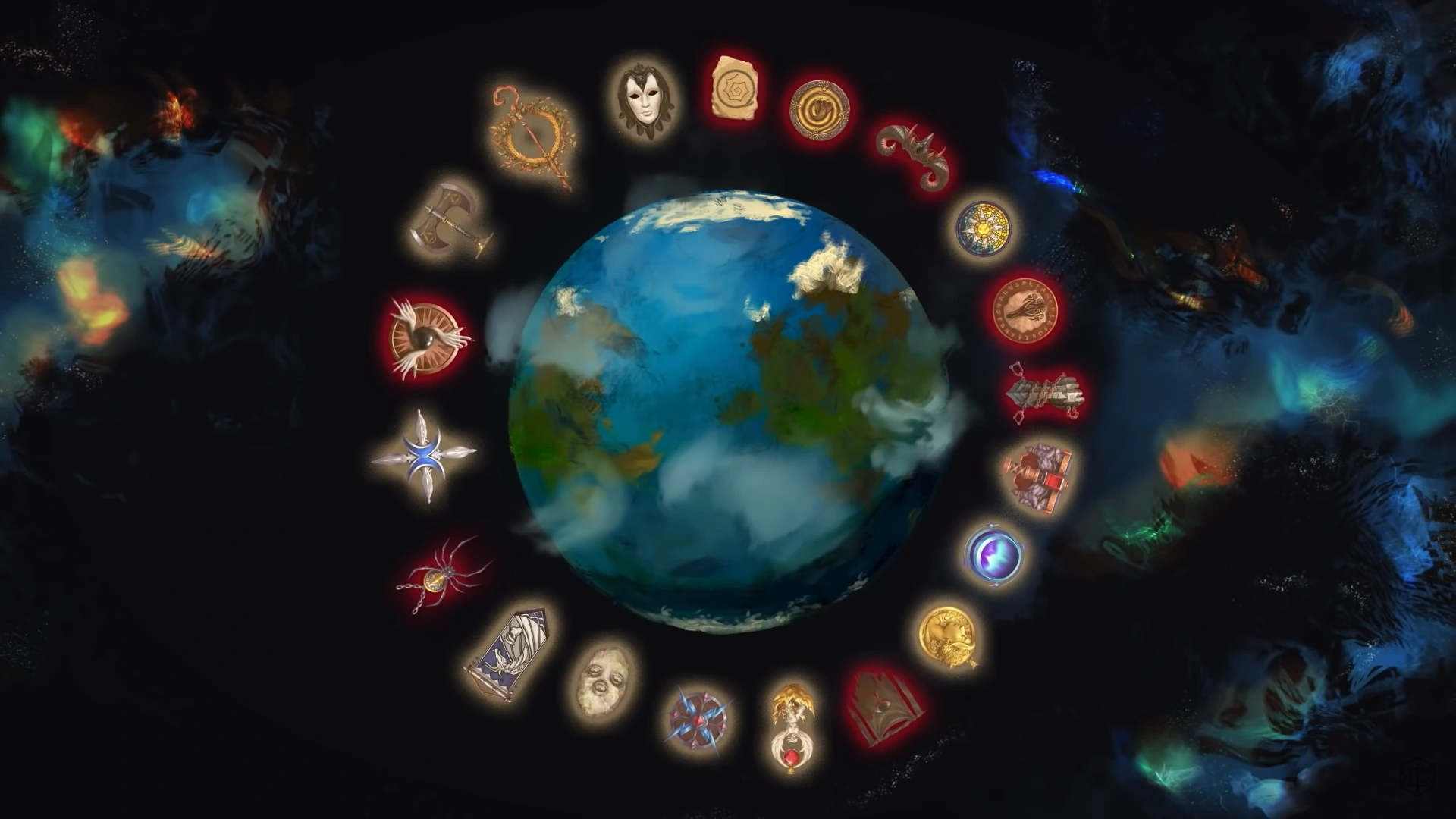

Screenshot of the Prime Deities and Betrayer Gods' symbols, by Cyarna Trim and Conceptopolis from "Exandria: An Intimate History" (Sx61) at 2:22.[art 1]
Deities are extremely powerful beings that represent and control aspects of reality, having because of this followers and servants among mortals.
History
Many of the known gods in the pantheon of Exandria fled from their original home, Tengar, the Eternal Palace,[1] when it was attacked by a destructive force against which they were defenseless, the god-eater Predathos.[2] They traveled through the cosmos and eventually arrived on Exandria, which at that time was at least partially a scene of elemental tumult and constant shifting change, inhabited by the Primordials[3] and eidolons, although portions of the planet were ordered and beautiful.[4] It is rumored that at that time, souls would return and be reborn to new life after death,[5] consistent with the mythology of the Luxon which holds that Luxon beacons were scattered during the age of the Primordials to enact just such a cycle of rebirth.[6]
The newly-arrived Protean Gods and the Primordials apparently existed in peace for some time, during a period known as the Founding in which the gods brought order to the chaotic portions of the world and then brought forth mortal creatures to also inhabit Exandria and which worshiped their creators.[7] Rumors say the cycle of rebirth was broken for these creatures, whose souls now went to dwell with the god they worshipped after death.[8] However, the major deities eventually split into two groups: the Prime Deities (who are generally seen as good- or neutral-aligned), who granted magic to mortals and who battled the Primordials who did not wish mortals to attain that much power; and the Betrayer Gods (who are generally evil-aligned) who embraced the Primordials' chaotic destruction of the mortal races following their gaining knowledge of magic.
In the late Age of Arcanum, a mortal woman ascended to godhood and replaced the god of death through a ritual they devised together.[9] In fear of the Raven Queen's achievement, the remainder of the pantheon swiftly destroyed and prohibited her rites,[10] and she herself took measures to ensure no one would be able to replicate it.[11] However, another powerful mage of the Age of Arcanum, Vecna, reconstructed an altered version of the Ritual of Seeding and attempted it, but the ritual was interrupted and he was all but destroyed (although he would succeed many centuries later, in 812 PD).[12][13] The Raven Queen's ascension also inspired the megalomaniacal malconvoker Vespin Chloras to try to replace the Lord of the Hells as a less destructive deity,[14] but in his failure to replicate her act he released the imprisoned Betrayer Gods back into the Material Plane, leading to the Calamity.[15]
Following the Divergence, in which the Prime Deities locked both the Betrayers and themselves away from Exandria behind a Divine Gate lest they further endanger it with their own conflicts,[16] multiple lesser powers rose up in the vacuum left by the withdrawal of the true deities, offering power to mortals and gathering worshipers. There were also less important deities supporting the main deities of the pantheon.[17][18]
Despite their mutual hostility after the Schism, the main gods of the Exandrian pantheon have declared armistices (if only temporarily) to deal with common threats, such as the flying city of Aeor during the Calamity,[19] or the potential release of Predathos after the apogee solstice of 843 PD.[20] This most recent conflict has caused most of the main pantheon (with the exception of the Arch Heart and the Matron of Ravens) to be ready to start a second Calamity to stop the plans of Ludinus Da'leth if everything else fails.[21] The Crisis of the Red Solstice was resolved when Bells Hells, after containing the Red End inside of Imogen Temult, managed to persuade the main pantheon to accept a new form of existence as "mortal deities", in a constant state of life, death, and rebirth, undetectable to Predathos. Then, the Divine Gate was shattered and the Matron of Ravens used the recently designed Rites of Catatheosis, channeling arcane, divine, and dunamantic magic through the body of Ashton Greymoore, to bind all of their divine souls to the Exandrian cycle of rebirth; after the goddess of fate promised the mortals gathered in Vasselheim that they would one day return, and after a magically stretched moment in which deities sent farewell visions to their followers,[22] she completed the ritual and she and her godly peers disappeared to be reborn.[23]
Prime Deities
- Avandra, the Changebringer:[24][25] Goddess of freedom, trade, travel, adventure, and luck
- Bahamut, the Platinum Dragon:[26] First of the metallic dragons and god of justice, honor, and good-aligned dragons
- Corellon, the Arch Heart:[27][28] Deity of art, beauty, the fey, and spring
- Erathis, the Lawbearer:[27][28] Goddess of civilization, laws, and peace
- Ioun, the Knowing Mentor:[29] Goddess of learning, prophecy, knowledge, and skill
- Kord, the Stormlord:[29][30] God of battle, competition, and storms
- Melora, the Wildmother:[29][31] Goddess of wild nature and the sea
- Moradin, the All-Hammer:[32] God of craft, creation, family, and legacy
- Pelor, the Dawnfather:[32][33] God of the sun, agriculture, and summer
- The Raven Queen, Matron of Death, also called the Matron of Ravens:[34][32] Ascended goddess of fate, death, twilight, and winter
- Sarenrae, the Everlight, also called Raei:[32] Goddess of redemption, compassion, healing, temperance, and the dawn
- Sehanine, the Moonweaver:[35][36] Goddess of misdirection, love, moonlight, and autumn
Betrayer Gods
- Asmodeus, the Lord of the Hells:[37] Devil god of domination, and ruler of the Nine Hells
- Bane, the Strife Emperor:[38] God of war and conquest
- Gruumsh, the Ruiner:[39] God of slaughter
- Lolth, the Spider Queen:[39] Goddess of deceit, shadows, and spiders
- Tharizdun, the Chained Oblivion:[40] Elder Evil and mad deity of destruction
- Tiamat, the Scaled Tyrant:[40] Queen of the chromatic dragons and goddess of greed, envy, hoarded wealth, and evil-aligned dragons
- Torog, the Crawling King:[40] God of torture and enslavement
- Vecna, the Whispered One:[12] Ascended god of secrets and necromancy
- Zehir, the Cloaked Serpent:[12] God of poisons, assassins, and darkness
Other gods
There are also some minor gods with presence and worship in and outside of Exandria, unrelated to those that came from Tengar:[41][42]
- Hoarmorath, a god of the sahuagin[43]
- Laduguer, a god of the duergar
- The Luxon, the First Radiance, deity of the Kryn Dynasty,[44] also worshiped as the "Beacon of Unknown Light" in Reaching Bluff[45]
- Orcus, the Demon Prince of Undeath, sometimes referred to as a Betrayer god of undeath,[46][47][48][49] despite not appearing on more traditional lists[37][50] and being described as a servant of the Betrayer Gods instead[51][52]
- Surtr, a god of the fire giants[fn 1]
- An unnamed frog god whose temple in the swamp near Stilben was occupied by sahuagin worshipers of Hoarmorath[53]
In the Brokenveil Marsh there is a menhir that spellcasters use as a focus for certain rituals and incantations. It originally acted as a monument to a dark, primordial god.[54]
Destroyed deities
There are certain gods who once inhabited Exandria, but who disappeared for different reasons and no longer exist:
- Ethedok, the Endless Shadow, the god of darkness and winter. They vanished at some point between the Founding and the Schism, devoured by the entity known as Predathos. The surviving gods banded together with the Primordial Titans to imprison Predathos within a shard of Exandria itself, thus creating the red moon Ruidus in that era.[55][56] Only a few ancient texts in Vasselheim, recovered by Baryn Vestisho and two other members of the Grim Verity, still record this god's existence.[57]
- Vordo, the Fateshaper, also known as the Golden Weaver, the god of fate and order. Vordo was devoured by Predathos after the destruction of Ethedok,[58] and similarly has been all but forgotten. What remained of their divine essence inside the Red End was freed in 843 PD by Imogen Temult, allowing Vordo to fully depart.[59]
- The Raven Queen's predecessor, the previous god of death. The mortal woman who became the Matron of Ravens performed a ritual by which she became the new goddess of death, destroying this god and sundering his name from reality,[60] although people are still aware he existed at some point. Before the deities' coming to Exandria, this god was known as "Nahal".[61]
- Crysa-Thul, the Stillborn God, a fetal deity who had a cult in Stilben until Vox Machina fought it and destroyed it.[62]
As of 836 PD, members of an ancient cult are said to live on the two islands of Fevergulf Lake, still mourning the loss of a forgotten god.[63]
While they never reached reality or were known in Exandria, there were also several "potential deities" that were destroyed in Tengar:
- Edun, a large form of kaleidoscopic twinkling lights, he was a respected figure in the Eternal Palace, and the first to be consumed by Predathos[64]
- Aily, a being of shifting color that left imprints of herself behind as she moved, she was the second to be consumed by Predathos, trying to rescue Edun[65]
- Nahala, a spirit who was close to Nahal, and the third known to be consumed by Predathos when she was trying to find Qsar[66]
- Qsar, an entity that was presumably consumed by Predathos or destroyed along with Tengar[67]
Lesser idols
Several other lesser idols are still known in the ninth century PD, some of them worshipped like gods, either freely or against social restrictions (like those of the Dwendalian Empire, where only certain cults are legal):[68]
- Arms of the Betrayers[69]
- Arioch, Duke of Chaos[70]
- Ceratos of Many Minds[71]
- The Demithore Eidolons, by the followers of the Loam and the Leaf[72]
- Desirat, the Twilight Phoenix[71]
- Ethel Rivergold[73]
- Galdric, the Moonlit Wolf[74]
- Graz'tchar, the Decadent End[74]
- The Hag Mother[44]
- Khedive Xundi, Lord of Silver Silt[74]
- Naviask[44]
- The Observer[45]
- Quajath, the Undermaw[44]
- Sahyaadon, the Keeper of the Savage Heart[75]
- The Sightless[45]
- The Traveler[44]
- Uk'otoa, the Leviathan Lord[6]
- Vesh, the Bloody Siren[6]
- Xalicas[6]
These lesser idols include several immortal beings of near-divine power (such as demigods) residing among the planes,[76] as well as particularly powerful individuals who reside on Exandria itself, whether they are creations of the gods, other entities that can grant magic, or even mortals who have gained nearly divine abilities[77][69] and thereby can grant magical powers to others.
Examples of these patrons are the following:
Archfey
The mighty rulers of different courts and/or domains of the Fey Realm. Immortal and immutable, they can manifest god-like abilities and influence their places of power to adapt to their desires.
Archdevils
The highest-ranking devils in the Nine Hells, and the ones who rule each of its layers, all of them answering (at least in theory) to the highest among them, Asmodeus, who rules the Ninth Layer. Regardless of their origins (corrupted souls, fallen angels, or fiends that have risen through the ranks), all of them have unique appearances and incredible powers that reflect their evil.
Demon lords
The chaotic rulers of the multiple layers and domains of the Abyss, so powerful that only through summoning rituals are they able to cross the Divine Gate. The most outstanding of them (although below deities of the same plane as Lolth or Tharizdun) are called Demon Princes.
Celestials
The inhabitants of non-evil planes, like the offspring of the gods or their servants, such as the angels. They often oppose and actively fight evil-aligned creatures, and the most powerful and proactive of them can offer their assistance to mortals and are capable of granting them magic.
Mortal champions
Certain mortals, whether through magical rituals, divine blessings, great deeds, or the active worship of others, are exalted to the point of becoming empowered beings of greater longevity and magic, able to share their power with those who serve them.
Powers
Deities are distinguished from mortal creatures by their unrivaled powers. The mages of Aeor distinguished the gods' abilities into seven categories:
- Divine Awareness: A god has truesight, blindsight, and tremorsense out to 120 feet. A god can speak and understand all languages, spoken and written, and communicate telepathically with any creature they can see. A god is immune to the charmed, frightened, stunned, blinded, and deafened conditions.[78]
- Divine Prowess: After rolling a skill check, a god doubles the result. After calculating all bonuses, a god doubles their passive skills.[79]
- Divine Vigor: A god regains all limited use class features at the beginning of each of their turns. A god is immune to exhaustion. After calculating all bonuses, a god's speed is doubled. A god has three legendary actions per round.[80]
- Divine Resistance: A god has five legendary resistances. After rolling a saving throw, a god doubles the result. A god is immune to all non-magical damage, damage from weapons that are not artifacts, and damage from spells of sixth-level or lower. A god has two "elemental" damage immunities and four damage resistances.[81]
- Divine Magic: Once per turn, a god can cast any cleric spell or domain spell (of a domain they can grant) at any level without using a spell slot. After calculating all bonuses, a god doubles the save difficulty class, range, area of effect, and duration of all spells.[82]
- Divine Potency: All damage a god deals via spells and weapon attacks is multiplied by 10. After rolling an attack roll, a god doubles the result. After calculating all bonuses, a god's armor class is doubled. A god's range with ranged weapons is doubled.[83]
- Divine Vitality: At the beginning of a god's turn, if they have not taken damage since the beginning of their last turn, a god regenerates all hit points. All death saving throws are considered natural 20s. A god's maximum, current, and temporary hit points are multiplied by ten, as well as hit points and temporary hit points restored by spells. A god is immune to the petrified, paralyzed, and poisoned conditions and disease.[84]
As the mortal avatars of the gods broke the wards of Aeor's Latimus Princeps, they immediately regained this level of power, and began to shed their flesh-and-blood forms. But as guest DM Brennan Lee Mulligan explained it, "the gods of Exandria are not supposed to be statblocks. They're supposed to be incalculably infinite. So even as you're breaking the wards, it's like these powers are even still fractional selves of the deities."[85]
Avatars
The avatar of a deity is a corporeal manifestation of that god and their powers, and it enacts their will. Gods can create an avatar out of their own power and in their own image (like Vecna did in Exandria shortly after ascending),[86] but sometimes (particularly for those beyond the Divine Gate) servants and divine champions must become avatars of the deities they serve. Examples of this are the Moonweaver sending a planetar to Rumblecusp and speaking through it,[87] in what could be interpreted as the angelic being acting as an avatar; and Yasha Nydoorin being named the Stormlord's avatar as the champion of the god.[88]
A particularly peculiar use of this ability happened during the first century of the Calamity, when the gods agreed to a truce to deal with Aeor, and devised a plan to infiltrate the flying city: some of them created mortal incarnations of themselves to use as tools for that eventual mission. These incarnations (aspects of their more divine selves, but still counted as avatars)[89] grew up as independent individuals who, in time, would understand their purpose and mission, acting according to their corresponding divine wishes, and having some powers connected to them, while still being technically mortal, and capable of dying (moment in which their essence would return to their corresponding deity).[90] When they successfully destroyed the wards guarding the Factorum Malleus of Aeor they gained more and more divine attributes, until they reached a point in which they abandoned their mortal forms, manifesting again as fully divine entities.[91] Although before and after the fall of Aeor it wasn't uncommon for gods to disguise themselves as mortals, that particular form of mortal-born avatar was less common. The All-Hammer used it to turn into Garen Hearthheart as a way to start working on the Divine Gate, but due to a miracle of the Moonweaver combined with a curse of the Lord of the Hells, he completely forgot his identity, so the Platinum Dragon followed him into the mortal world, suffering the same fate for many decades. The last known use was when the Moonweaver herself created the mortal form of Liana in order to experience familial love during the last years of the Calamity, managing to regain her memories somewhat soon. The goddess left Exandria with most of her divine siblings during the Divergence, setting an example for the rest of the pantheon on how to maintain connection with their followers even from beyond the Divine Gate;[92] The Platinum Dragon and the All-Hammer were the last ones to cross the Gate, since only at the end of Garen's mortal life was the keystone of the lattice finished.[93]
Kima of Vord, a paladin of Bahamut, received some of her fighting implements directly from an avatar of the Platinum Dragon.[94]
Becoming a deity
While a deity's position tends to remain stable throughout the ages, there have been instances in Exandria's history where different entities have risen to godhood, creating their own position in the pantheon or dethroning another divinity in the process, each case through various methods.
Natural ascension
Certain entities, if powerful enough, can become deities in their own right, especially when they have worshipers and a divine realm that empowers them.
That may be the case for Asmodeus, who claimed to have come to Exandria as an angel, a celestial of light,[95] and he is said to have celestial blood.[37] The Chronicle of Vasselheim says that a fallen angel claimed lordship over the newly forged Hells.[96] That said, Asmodeus also claims the gods as his siblings, and he traveled to Exandria with them,[97][98] rather than arriving later as the Chronicle of Vasselheim says other celestials did.[99]
Worshiped like a god
While certain individuals with magical potential can be strengthened through the worship and loyalty of others (as is the case for some mortal champions),[74] when this worship is dedicated to a more powerful entity, the nature of their power changes and begins to grow, also establishing a deeper connection between said being and the people who worship them.
The best example of this is Artagan of the Morncrown. An archfey with no allegiances and great power on his own, when he traveled to the Material Plane after a long exile imposed by Corellon[44] he met a young tiefling, Genevieve Lavorre, with whom he struck up a friendship due to their similar nature; in her childlike innocence the girl saw Artagan as a god, and through that worship she eventually became his cleric. The archfey discovered that through the unconditional faith of the young girl (now called Jester) and others like her, he was becoming empowered, so he started a cult under an alias, The Traveler, granting magic and boons to those that followed his philosophy.[100] However, while Artagan's "godly" power grew to an extent unexpected (even to himself) it is unknown if he could have ever achieved full godhood, as he himself curbed his cult, overwhelmed by the number of voices of worshipers that contacted him, being very difficult for him to answer them all.[101][102] At Traveler Con his true identity was revealed (with some twists) and while he retained the ability to bestow magic on others, from then on he mainly focused on his first devotee, Jester.[103][104]
Divine usurpation
A god's position in the pantheon can be challenged by another entity, and if that being manages to gain dominance, it destroys its predecessor. The Lord of the Hells hinted that it was possible for immortal beings to go through this process, and was extremely surprised to discover that a mortal had managed to do so.[105] Although the process allows the usurper to become a deity in their own right, it does not guarantee that they can claim their predecessor's entire portfolio, and other deities can benefit from the unclaimed aspects of the destroyed deity's domain.[106]
Ritual of Seeding
This ritual was created by a mortal woman during the Age of Arcanum. She was consorting with the First God of Death and was his worshiper, but during an apogee solstice she challenged her partner and took his place in the pantheon.[107][108] By doing so she sundered his name from reality,[109] making the memory of her predecessor more easily lost over the centuries.[110]
Throughout the rest of the Age of Arcanum many arcanists tried to repeat the ascension of the goddess of death, now known as The Raven Queen (since she herself had hidden her original name), but none were successful, and the Prime Deities made sure that no other mortal accessed such dangerous knowledge, to avoid a second ascension.[111] Despite their efforts, the lich Vecna managed (by unknown means, shocking the gods themselves)[112] to recover said knowledge, recreating his own Ritual of Seeding successfully,[113][114] and achieving godhood at last,[115] though unlike the Raven Queen he is not known to have usurped another deity.
Outside Exandria
In the Exandria cosmos but beyond Exandria are other gods.[116] Other gods associated with Critical Role, which may or may not be connected to the Exandria cosmos, include:
The gods of Aramán
A pantheon whose members were destroyed by their mortal "children" in the Shapers' War:[117]
- Azgra the Conqueror, shaper of the orcs, god of war, conquest, and suffering[118][119]
- Ilumi the Weaver, shaper of the gnomes, goddess of magic[120] and the moon[117]
- Omra the Hunter, awakener and shaper of the beastfolk,[121] god of the wilds[117]
- Rauwyn the Trickster, shaper of the halflings, goddess of trickery and fortune[122]
- Sylandri the Green Mother, shaper of the elves, goddess of life and the woodlands[123]
- Tansul the Bright, shaper of the humans, god of the sun[124][125][117]
- Trozhna the Skilled, shaper of the dwarves, goddess of the forge[126][117]
The Faint Divinities
An animistic pantheon of unpredictable deities, mostly created by more distant and powerful entities, and worshiped in places such as Fanewick.[127][128]
- Fulg, Stacker of Stones, a lesser protector of bivalves and limpets, as well as their harvesters; he accepts stacked river rocks as offerings, and doesn't care about problems bigger than him.
- Hyacynis, They Who Spread Small Blossoms, a deity of bees and flowers; they see the unnatural spring in Fanewick as a boon, since it expands their domain.
- Ikla, the Sky Painter, the deity of the weekly day-night cycle, and the one who colors the sky each dawn and dusk; although their talent is undeniable, they are lazy and easily offended if bothered at any moment that isn't sunrise or sunset.
- Nikta, the Shepherd of the Seasons, also called the Great Owl, currently the most powerful goddess, who protected the land and used her magical eyes to maintain balance in nature through the cycle of growth and decay; the forces of Haven plucked out her Reaping Eye (the one she used to cause ruination), leaving her only with her Sowing Eye (used to cause ripening), thus causing an everlasting spring.
- Oove, the Watcher of the Night Bloom, a mysterious night god who allegedly watches Fanewick from the moon; no one has ever seen him, but he is said to guide lost travelers to sources of light (such as the bioluminescent night bloom flowers), and those who displease him (by harming nocturnal creatures, for example) to dangerous terrain.
- Qui'Gar, Whispered Sweetness for a Thorny End, a goddess of death for those who died in thorny bushes and briar patches; she used to live a quiet existence, but the Witherwild has made the type of death she presides over way more common.
- Rohkin, the Wandering Horn, a god of horned creatures who preserved the balance between nature and civilization and prevented overhunting; after the actions of Haven and the beginning of the Witherwild he has witnessed his own herds transforming into dangerous monsters.
- Shun'Aush, the Granite Ophid, once the most powerful of his kind, allegedly killed by the forces of Haven; from his stone body a disease known as the Serpent Sickness was unleashed.
The Fallen, Forgotten, and New Gods
A pantheon composed by the old deities that shaped the mortal world and its people (even walking among them) and their successors; these younger deities stay in the Hallows Above behind a barrier that can't be crossed without a great sacrifice, while the older deities are either abandoned in the Mortal Realm or banished to the Circles Below.[129][130]
- Kudamat, the First Doom, a Forgotten God of the Drylands trapped within Godfell Mountain, from where it is prophesied that one day he will escape to cause destruction, with the help of colossi that contain his essence.[131]
- Ondra, a goddess of the wild and wooded places, worshiped in the realm of Lochspire; the Emerald Sky is her sacred forest, and the core of her essence.[132][133]
The Veiled Gods
A mysterious pantheon that used to be worshiped in the Halcyon Domain, until the actions of God-King Othedias caused them to abandon that realm.[134] Their sculptures have stone veils and masks covering their faces, while their servants' representations have just veils.[135]
- Aratu, the Dawning Sorrow,[136] a deity to whom people pray in times of atonement, risk, and sacrifice.[137][138][139]
- Tyris, a dark and fearsome but benign god of hope, and a protector of family and hearth who swallowed the very shadows that threatened them.[140]
Trivia
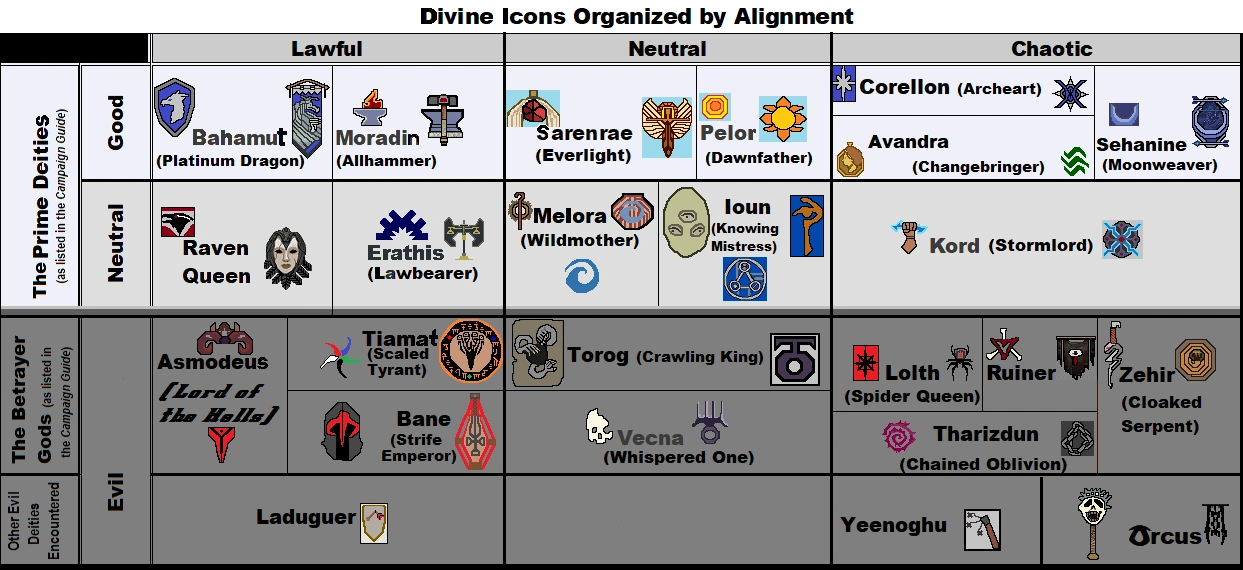

Main Encountered Deities, with their symbol icons, arranged by alignment. Note that Yeenoghu is considered a lesser idol, given his status as a demon lord, as is Orcus, although the latter is sometimes treated as a god.
- Although most of the primary deities in the Critical Role pantheon are from the Dawn War pantheon, Sarenrae was imported into the Fifth Edition Dungeons & Dragons game from the cast's original Pathfinder game so Ashley Johnson wouldn't have to switch deities.[141]
- According to the page dedicated to Quian on the Vox Machina Wiki which was created by Matthew Mercer before Critical Role began, Delleb was the god of intellect and study rather than Ioun in the pre-stream home game. Since the transition there has been no mention of Delleb, and the Cobalt Reserve to which Quian belongs has been consistently dedicated to Ioun.
- As a result of their origins, the names of most of the deities of the Exandrian pantheon are trademarked by Wizards of the Coast and Paizo. This means that, while the names can be used freely in Explorer's Guide to Wildemount and Critical Role: Call of the Netherdeep (since the books are published with Dungeons & Dragons), only the epithets are used to refer to them in official Critical Role content such as The Legend of Vox Machina, novels set in Exandria or the sourcebooks published under Darrington Press LLC (like the Tal'Dorei Campaign Setting Reborn). During Campaign One and most of Campaign Two Matt Mercer and the rest of the cast used the names of the gods more often (since, as Fan Content, they are free to do so), but during Campaign Three and Exandria Unlimited the epithets are used almost exclusively.
- Although they are original, the names that the deities of the main pantheon used in Tengar were improvised by Brennan Lee Mulligan and were supposed to be incomprehensible. According to Matt, the way they appear in subtitles and transcripts are an approximation mortal minds are able to understand.[142]
- The Cobalt Soul states that, while smaller and/or younger deities do exist and have cults in Exandria, they are notoriously difficult to track.[143]
- By the end of the Age of Arcanum those lesser deities didn't have a known presence in Exandria, or if they did, it was extremely reduced and localized.[144] Similarly, when Aeor was preparing to use the Factorum Malleus, their tests didn't include the destruction of an actual "spare" deity, and in that case it might have been because part of the process included scrolls with all the available information about the deities written in Celestial[145] (something easy to achieve with the main pantheon, but more complicated with lesser known gods).
- Luthic, a cave goddess seen as the Ruiner's wife in other worlds,[146] has one of her creations, the orogs, present in Exandria, although Explorer's Guide to Wildemount doesn't specify if Exandrian orogs share the same type of origin described in the Monster Manual.[147]
- The gods coming from Tengar share a divine spark of indescribable color, which Predathos can sense.[148]
- Gods can have different names or titles depending on the geographical region of their worshipers. An example of this is the continent of Marquet, in which the Raven Queen is called the Duskmaven[149] and Melora is called Serataani.[150]
- According to legend, the primordial titans and the gods met for the first time in the Ascendant Bridge Mountain, the tallest point in Exandria and the first place the deities visited when they reached the planet.[151]
- There is a book, Delando's Compendium of Pantheon and Hierarchy, that talks about the different deities worshiped in Exandria, and one of its chapters, "Relation and Communication Between Prime Deities", even goes into detail about families of followers of specific gods and their connections (such as the one shared by the Clay, Dust, and Stone families).[152]
- The divine realms of the gods, which act as their seats of power inside existing planes or apart from them, are directly tied to them, so if one of them dies permanently without anyone taking their place, the realm itself fades, releasing the mortal souls it contains in the process.[153]
- Outside of Exandria there is a powerful entity only known as "the Lady of Pain", of whom a statue was erected at an embassy in Pandemonium. While the memories of her seem to survive even madness,[154] her nature (including whether or not she is a goddess) has not been established in Critical Role.
- The gods are able to perceive the devotion of their followers. A mildly devoted person could pray to several deities without each of them being aware of the prayers addressed to others; on the other hand, a passionate follower who began praying to a second entity would alert the first that their devotion had become divided.[155]
- Deities can choose to enhance the abilities of a mortal for a moment, even if that mortal isn't a follower. For example, when Keyleth of the Air Ashari gave a speech in front of the army of the Exandrian Accord, her words inspired many of the troops although normally the Inspiring Leader feat is limited to six listeners.[156]


Artagan and "Mister Demeanor", by Aviv Or and Cris Peter from The Tales of Exandria: Artagan #1.[art 2]
- At some point before or during the Calamity an entire elven culture tricked by the archfey Artagan ended up worshiping "Mister Demeanor", a whale carcass; this act was punished by Corellon, who banished Artagan to the Fey Realm without a way of returning to Exandria by his own means.[44]
- Although most gods are revered by sentient beings, with their portfolios focused on them, a few of them have specific animals associated to them that are considered sacred: the Matron of Death (the raven), Raei (the phoenix), Lolth (the spider), and Zehir (the snake). Both Melora and Kord also have an association to animals (since the goddess of nature is worshiped even by beasts, and the god of competition is often depicted wrestling one), but it is less specific.
- Religions organized around different deities may have different rules and taboos depending on the god and the region. In Vasselheim, for example, many clergy members avoid alcoholic beverages.[157]
- When asked about what new gods would they add to the Exandrian pantheon, some members of the cast proposed several ascensions:[158]
- Liam O'Brien proposed Devexian as a god of technology and industry.
- Ashley Johnson proposed her own character, Fearne Calloway, as a goddess of fun, silliness and theft, with her chaos competing with Artagan's. She also proposed Morrigan the Fatestitcher as some sort of goddess of duality.
- Marisha Ray proposed Marion Lavorre as a goddess of sensuality, burlesque, drag queens, and cake.
- Dani Carr proposed Galdric the Moonlit Wolf as a god of animals.
- Before taking part in the Rites of Catatheosis, the gods spoke to their followers to assure them that they would still be around and will be back in some form. Matt Mercer confirmed that The Wildmother talked to both Caduceus Clay and Fjord before she was reincarnated.[159]
- Matt has confirmed that although he has some ideas about the gods' new mortal incarnations, he doesn't want to confirm stuff about it yet, so that other people that want to explore that in their own games aren't constrained by established canon.[160]
- In the world of Aramán, a divine cardinal direction is the name given to high concepts associated to godly domains that mortals worship directly, rather than through a divine figure personifying it.[161]
Notes
- ↑ Although his temple was seen in the Elemental Plane of Fire, the fire giants living there have traveled between Exandria and this plane, so the cult to this god probably has presence in this world of the Material Plane.
References
- ↑ See "Downfall: Part One" (3x99) at 0:14:50.
- ↑ See "Downfall: Part One" (3x99) from 0:21:02 through 0:30:27.
- ↑ See "Downfall: Part One" (3x99) at 0:41:20.
- ↑ See "The Cradle's Convocation" (3x10⁴) from 1:43:46 through 1:44:37.
- ↑ See "The Cradle's Convocation" (3x10⁴) at 1:44:43.
- ↑ 6.0 6.1 6.2 6.3 See Explorer's Guide to Wildemount, p. 33.
- ↑ See "The Cradle's Convocation" (3x10⁴) at 1:43:46.
- ↑ See "The Cradle's Convocation" (3x10⁴) at 1:45:02.
- ↑ See "A Test of Fate" (3x10⁹) at 4:16:28.
- ↑ See Tal'Dorei Campaign Setting, p. 17. See also Explorer's Guide to Wildemount, p. 25.
- ↑ See "A Test of Fate" (3x10⁹) at 4:26:51.
- ↑ 12.0 12.1 12.2 See Explorer's Guide to Wildemount, p. 29.
- ↑ See Tal'Dorei Campaign Setting, p. 38.
- ↑ See "4-Sided Dive: Oh My Gods" (4SDx26) at 1:36:20.
- ↑ See Tal'Dorei Campaign Setting, p. 6. Also Explorer's Guide to Wildemount, p. 12.
- ↑ See CR Cooldown - C3 E109 (subscription required) at 8:23 (Transcript).
- ↑ The Chronicles of Exandria - The Mighty Nein, p. 182.
- ↑ The entry for the Arms of the Betrayers says "before the Calamity, eight of the Betrayer Gods" crafted those weapons, which may imply that at that point there were already more than eight deities on the Betrayer Gods' side, or may simply reflect that Vecna was not yet among their number. See Explorer's Guide to Wildemount, p. 30.
- ↑ See Explorer's Guide to Wildemount, p. 121.
- ↑ See "Bloody Flowers" (3x67) from 4:26:11 through 4:27:20.
- ↑ See "Under the Arch Heart's Eye" (3x10⁷) at 3:50:09.
- ↑ See "A New Age Begins" (3x121) at 3:16:54. See also at 3:42:41 when Deanna realizes all those of faith received visions.
- ↑ See "A New Age Begins" (3x121) at 3:43:35.
- ↑ See Explorer's Guide to Wildemount, p. 20.
- ↑ See Tal'Dorei Campaign Setting Reborn, p. 28.
- ↑ See Explorer's Guide to Wildemount, p. 21.
- ↑ 27.0 27.1 See Explorer's Guide to Wildemount, p. 22.
- ↑ 28.0 28.1 See Tal'Dorei Campaign Setting Reborn, p. 29.
- ↑ 29.0 29.1 29.2 See Explorer's Guide to Wildemount, p. 23.
- ↑ See Tal'Dorei Campaign Setting Reborn, p. 30.
- ↑ See Tal'Dorei Campaign Setting Reborn, p. 31.
- ↑ 32.0 32.1 32.2 32.3 See Explorer's Guide to Wildemount, p. 24.
- ↑ See Tal'Dorei Campaign Setting Reborn, p. 32.
- ↑ See Tal'Dorei Campaign Setting Reborn, pp. 32–33. See also pp. 213 and 274–275.
- ↑ See Explorer's Guide to Wildemount, p. 25.
- ↑ See Tal'Dorei Campaign Setting Reborn, p. 33.
- ↑ 37.0 37.1 37.2 See Tal'Dorei Campaign Setting Reborn, p. 34.
- ↑ See Explorer's Guide to Wildemount, p. 26.
- ↑ 39.0 39.1 See Explorer's Guide to Wildemount, p. 27.
- ↑ 40.0 40.1 40.2 See Explorer's Guide to Wildemount, p. 28.
- ↑ See "A New Age Begins" (3x121) at 1:05:35. Predathos can only feed from the "kin" of the original deities from the Eternal Palace (including those who became deities later). After the Rites of Catatheosis it wasn't able to track, for instance, The Chained Oblivion, who was entirely different.
- ↑ For deities worshiped in other worlds see the Outside Exandria section.
- ↑ See Vox Machina Origins 2.
- ↑ 44.0 44.1 44.2 44.3 44.4 44.5 44.6 See Explorer's Guide to Wildemount, p. 32.
- ↑ 45.0 45.1 45.2 See Tal'Dorei Campaign Setting Reborn, p. 41.
- ↑ See "Voice of the Tempest" (1x90) at 1:26:11.
- ↑ See "Glass and Bone" (1x08) at 55:49.
- ↑ See "The Temple Showdown" (1x11) at 11:22. See also 4:21:40.
- ↑ See "Escape from the Underdark" (1x13) at 23:30.
- ↑ Nor is a symbol of Orcus included on an ever-shifting, stained glass mosaic in the Betrayers' Rise that shows the symbols of all the other known Betrayer Gods. See Call of the Netherdeep, p. 68. By contrast, the symbol of the Whispered One does appear circa 836 PD, though he only ascended to godhood in 812 PD.
- ↑ See Tal'Dorei Campaign Setting, p. 56.
- ↑ See Tal'Dorei Campaign Setting Reborn, p. 86.
- ↑ See Vox Machina Origins Series I, Issue #2.
- ↑ See Explorer's Guide to Wildemount, p. 255.
- ↑ See "Axiom Shaken" (3x43) from 3:03:05 through 3:05:41.
- ↑ See "Dark Portents" (3x29) at 2:54:59.
- ↑ See "Axiom Shaken" (3x43) at 3:02:19.
- ↑ See "Axiom Shaken" (3x43) at 3:03:59.
- ↑ See "Predathos Awakened" (3x119) from 1:43:27 through 1:45:19.
- ↑ See "Excelsior" (E3x01) at 3:57:45.
- ↑ See "Downfall: Part One" (3x99) at 0:20:15.
- ↑ See "The Story of Vox Machina" (Sx06) at 0:00:11.
- ↑ See Explorer's Guide to Wildemount, p. 139.
- ↑ See "Downfall: Part One" (3x99) at 0:15:33.
- ↑ See "Downfall: Part One" (3x99) at 0:24:20.
- ↑ See "Downfall: Part One" (3x99) at 0:28:29.
- ↑ See "Downfall: Part One" (3x99) at 0:28:33.
- ↑ See Explorer's Guide to Wildemount, p. 35.
- ↑ 69.0 69.1 See Explorer's Guide to Wildemount, p. 30.
- ↑ See "Dignity: An Adventure with Stephen Colbert" (Sx67) at 0:03:52.
- ↑ 71.0 71.1 See Explorer's Guide to Wildemount, p. 31.
- ↑ See "Faith or Famine" (3x60) at 2:19:24.
- ↑ See "Tag Team at the Teeth – Beyond the Shroud" (Sx98) at 4:17:13.
- ↑ 74.0 74.1 74.2 74.3 See Tal'Dorei Campaign Setting Reborn, p. 40.
- ↑ See "Call of the Wild" (3x41) at 1:25:44.
- ↑ See Tal'Dorei Campaign Setting Reborn, p. 27.
- ↑ See Tal'Dorei Campaign Setting Reborn, p. 39.
- ↑ See "Downfall: Part Three" (3x101) at 4:52:40.
- ↑ See "Downfall: Part Three" (3x101) at 2:13:14.
- ↑ See "Downfall: Part Three" (3x101) at 5:05:16.
- ↑ See "Downfall: Part Three" (3x101) at 4:30:51.
- ↑ See "Downfall: Part Three" (3x101) at 4:17:34.
- ↑ See "Downfall: Part Three" (3x101) at 4:19:10.
- ↑ See "Downfall: Part Three" (3x101) at 4:18:08.
- ↑ See CR Cooldown | C3 E101 (subscription required) on Beacon.
- ↑ See "The Endless Atheneum" (1x10⁶) at 2:24:55.
- ↑ See "Traveler Con" (2x10⁸) from 2:14:21 through 2:21:04.
- ↑ See "The Neverending Day" (2x125) at 3:36:22.
- ↑ See CR Cooldown | C3 E99 (subscription required). (Transcript).
- ↑ See "Downfall: Part One" (3x99) at 3:00:46.
- ↑ See "Downfall: Part Three" (3x101) at 0:56:31. See also from 2:13:14–5:05:33.
- ↑ See "Mirror and Key" (E4x03) at 2:45:26.
- ↑ See "By Heart Alone" (E4x04) at 5:18:21.
- ↑ See "Breaching the Emberhold" (1x06) at 2:35:56.
- ↑ See "Bitterness and Dread" (E3x02) at 4:13:44.
- ↑ See Explorer's Guide to Wildemount, pp. 11–12.
- ↑ See "Fire and Ruin" (E3x04) at 1:04:04.
- ↑ See the recounting of the collapse of Tengar. See "Downfall: Part One" (3x99) from 0:13:11 through 0:43:14. Imri's form began to take the shape of Asmodeus before the refugees arrived on Exandria.
- ↑ See Tal'Dorei Campaign Setting Reborn, p. 14.
- ↑ See "With Great Power..." (2x94) from 3:56:35 through 3:58:12.
- ↑ See "With Great Power..." (2x94) from 3:52:58 through 3:59:37.
- ↑ See "Blessing in Disguise" (2x95) at 38:20.
- ↑ See "A Walk to Warmer Welcomes" (2x124) at 3:40:09.
- ↑ See "Hell or High Water" (2x136) at 0:18:48.
- ↑ See "Fire and Ruin" (E3x04) at 1:20:43.
- ↑ See "Duskmeadow" (1x57) at 0:57:56.
- ↑ See Tal'Dorei Campaign Setting, p. 6.
- ↑ See "Elysium" (1x10⁴) from 49:10 through 49:30.
- ↑ See "Excelsior" (E3x01) at 3:57:45.
- ↑ See Tal'Dorei Campaign Setting, p. 17.
- ↑ See "Elysium" (1x10⁴) from 49:35 through 50:00.
- ↑ See "Elysium" (1x10⁴) from 49:10 through 49:30.
- ↑ See "Unfinished Business" (1x100) from 5:37:30 through 5:38:20.
- ↑ See "Race to the Tower" (1x10²) from 1:45:55 through 1:48:45.
- ↑ See "The Endless Atheneum" (1x10⁶) from 1:23:25 through 1:24:25.
- ↑ See "Bawdy Basement Belligerence" (3x44) at 3:20:56. "It only feeds on divinity of that strength. There are others beyond this world that it seeks thereafter."
- ↑ 117.0 117.1 117.2 117.3 117.4 "The Lore Keeper’s Ledger: Dangers in Dol-Makjar!" email from Critical Role, Dani Carr, and Jared Deiro to Beacon subscribers, 4 May 2026.
- ↑
 CR Cooldown C4 E001 at 16:55 (subscription required) (Transcript).
- ↑ See "Broken Wing" (4x02) at 2:35:41.
- ↑ See "Knives and Thorns" (4x06) at 0:27:16.
- ↑ See "Good Tidings" (4x24) at 4:34:33.
- ↑ See "Broken Wing" (4x02) at 2:45:19.
- ↑ See "The Fall of Thjazi Fang" (4x01) at 4:11:15.
- ↑ See
 Critical Recap: Critical Role C4E02 “Broken Wing” on CritRole.com . Jared Deiro describes Tansul as a "fallen shaper".
- ↑ See "Broken Wing" (4x02) at 4:24:03.
- ↑ See "Branching Paths" (4x05) at 1:55:44.
- ↑ Daggerheart System Reference Document 1.0 (2025), p. 113-118.
- ↑ Daggerheart Corebook (2025), p. 11.
- ↑ Daggerheart Quickstart Adventure (2025), p. 22.
- ↑ Daggerheart System Reference Document 1.0 (2025), p. 106, 107 and 110.
- ↑ Daggerheart Core Rulebook (2025), p. 309.
- ↑ See "Critical Role plays Daggerheart" (Sx83) at 0:24:15.
- ↑ See "The Menagerie Returns!" (Sx84) at 1:31:16.
- ↑ See "Age of Umbra: Desperloch" (AUx01) at 0:07:59.
- ↑ See "Age of Umbra: The Lost Monastery" (AUx02) at 2:06:11.
- ↑ See "Age of Umbra: The Lost Monastery" (AUx02) at 2:12:52.
- ↑ See "Age of Umbra: The Rampart and Beyond" (AUx04) at 0:37:39.
- ↑ See "Age of Umbra: Ages of Pain" (AUx05) at 0:34:37.
- ↑ See "Age of Umbra: The Unforgiving City" (AUx06) at 2:02:40.
- ↑ See "Age of Umbra: The Unforgiving City" (AUx06) at 0:13:20.
- ↑ Matthew Mercer commented on Sarenrae's role on Exandria and her relationship with other gods.
- ↑ See "Wrap Up: Campaign 3 and the Era of Reclamation" (Sx94) at 0:46:26.
- ↑ The Chronicles of Exandria - The Mighty Nein, p. 182.
- ↑ See "Excelsior" (E3x01) at 3:57:44. The mages attempting to achieve divinity didn't try it with lesser gods, only with the main known pantheon.
- ↑ See "Downfall: Part Three" (3x101) at 1:26:25.
- ↑ See D&D: Monster Manual (2014), 5th ed., p. 247.
- ↑ See Explorer's Guide to Wildemount, p. 113.
- ↑ See "The Hallowed Cage" (3x118) at 4:44:36.
- ↑ See "Make It Fashion" (3x12) at 2:33:33.
- ↑ See "Compulsions" (3x40) at 3:33:45.
- ↑ See "Somewhere Out There" (3x59) at 4:02:56.
- ↑ The Chronicles of Exandria - The Mighty Nein, p. 152.
- ↑ See "A New Age Begins" (3x121) at 1:00:30.
- ↑ See "The Search For Bob" (Sx45) at 2:00:22.
- ↑ See "Unseelie Interrupted" (3x10⁶) at 0:46:32.
- ↑ See "Assault on the Malleus Key" (3x113) at 1:11:54.
- ↑ See "The Assembling of Legends" (3x112) at 3:06:54.
- ↑ See "4-Sided Dive: Wrong Distance Relationships" (4SDx13) at 0:38:32.
- ↑ Fireside Chat LIVE with Matthew Mercer | Campaign 3: Bells Hells Finale at 08:26 (subscription required).
- ↑ See "Wrap Up: Campaign 3 and the Era of Reclamation" (Sx94) at 0:17:59.
- ↑ See "Visions of Shadow & Stone" (4x16) at 2:35:49.
Art:
- ↑ Screenshot of the Prime Deities and Betrayer Gods' symbols, by Cyarna Trim and Conceptopolis from "Exandria: An Intimate History" (Sx61) at 2:22. Used with permission.
- ↑ Artagan and "Mister Demeanor", by Aviv Or and Cris Peter from The Tales of Exandria: Artagan #1. This file is a copyrighted work. Its use in this article is asserted to qualify as fair use of the material under United States copyright law.
| |||||||||||||||||||||||||||||||||||||||||||||||||||||
| ||||||||||||||||||||||||||||||||